Tuesday, June 7, 2022

Redistricting Now Complete in All States (NATIONAL)


With New Hampshire finally determining how to draw the lines between its two congressional districts, all states have now completed redistricting for the 2022 elections (six states only have one U.S. House seat, so redistricting is irrelevant there).

Expert opinion varies a tiny bit on which party got the best of redistricting, but any advantage to either party deriving purely from redistricting is likely to be small. 

Five-Thirty-Eight's tracker projects an increase of six Democratic-leaning seats compared to the previous map. However, "After accounting for incumbency... Republicans are actually the ones who have gained ground from redistricting: The GOP is positioned for a net gain of three to five seats in 2022 just thanks to the new lines alone."

Dave Wasserman of the Cook Political Report tweeted the following on May 19:


Something everyone seems to agree on is that the number of truly competitive seats has declined tremendously.

Though all states completed their redistricting process, there are still some pending court cases. Just yesterday, in fact, a federal judge in Louisiana blocked that state's congressional map from going into effect, saying that application of the Voting Rights Act in this context would require two (not the current one) majority-Black districts. This decision is being appealed and may end up at the U.S. Supreme Court, which previously blocked a similar ruling with regard to Alabama from going into effect.

Although court challenges have benefited the Democrats in some states, setbacks for the Democrats in New York, Ohio, and Maryland have limited their potential gains.

Friday, February 4, 2022

Politico (2/4/22) on Court Challenges to Redistricting Maps Around the Country (NATIONAL)

Politico provides an overview of the states in which legislatively enacted redistricting maps have been challenged in state and federal courts. In some states (such as Ohio and Pennsylvania), courts have already ruled, whereas in others (e.g., Florida), the cases are pending. 

The article quotes Representative Sean Patrick Maloney (Democrat-NY), chair of the party's congressional campaign committee, as saying of the court challenges that, "We're not taking anything for granted but we're doing a hell of a lot better than I thought we would."

UPDATE: In a ruling released roughly within the past hour, the North Carolina Supreme Court has struck down that state's redistricting map. Like rulings in other states, the one in North Carolina should help the Democrats.

Monday, January 31, 2022

Five-Thirty-Eight (1/31/22) on Potential U.S. House Districts for New York State

Five-Thirty-Eight is out today with an in-depth examination (including diagrams) of a proposed map before the New York legislature to determine the state's U.S. House districts. The article describes the plan, which could gain the Democrats three seats in the Empire State, as a "a good possibility [to pass] but far from a certainty." 

The article hits a number of themes, including the parts of the state in which redrawn districts would likely shift from lean-Republican to lean-Democratic; the possible ways in which the plan could fail either in the legislature or in the courts; and why the final drawing of districts almost certainly will fall to the legislature, rather than to the state's bipartisan districting commission.

Friday, January 14, 2022

Five-Thirty-Eight (1/14/22) on Ohio Supreme Court's Rejection of GOP Redistricting Map (OHIO)


Nathaniel Rakich at Five-Thirty-Eight examines the Ohio Supreme Court's rejection of the congressional map passed by the state's Republican-majority legislature and the decision's possible implications for the partisan makeup of the state's future U.S. House delegation (LINK). Rakich also looks at which other states have thus far passed highly partisan maps (by statistical indicators) that may be vulnerable to court challenges.

Sunday, December 26, 2021

Wasserman on Twitter (12/22/21): Redistricting "Close to a Wash" (NATIONAL)


Redistricting expert Dave Wasserman released the following tweet a few days ago. It is much better news for Democrats than would have been expected at the beginning of the redistricting cycle. Wasserman still considers the Republicans heavy favorites to take the US House majority, but this prediction is based on President Biden's current low job approval, not on redistricting...

Friday, December 24, 2021

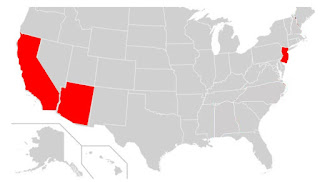
Politico on California (12/21/21), Arizona (12/22/21), and New Jersey (12/22/21)


Three recent articles from Politico detail the new maps in three states. You can click on the names of the states to access the full articles. Below are some key quotes from these articles, with my occasional comments (in purple) to add context.

CALIFORNIA:  "This is the high end of what was a probable outcome for Democrats," said Paul Mitchell, a political data analyst and owner of the firm Redistricting Partners. "This was definitely a good outcome for Democrats. Republicans have 11 current members — in these maps they should only be sending nine back to Congress in 2022." 

California will be losing a seat due to population, so will now have 52 representatives.

ARIZONA: "Arizona, one of the most bitterly divided swing states, finalized a new congressional map that could hand the GOP six of its nine congressional districts in 2022." 

 "The state’s redistricting commission on Wednesday approved a layout that creates two true swing seats in the suburbs of Phoenix and Tucson — currently held by GOP Rep. David Schweikert and retiring Democratic Rep. Ann Kirkpatrick — while very possibly dooming Democratic Rep. Tom O'Halleran in the northeast half of the state." ... 

 “The map achieves what Democrats say they want nationally. It maximizes the number of competitive seats in Arizona,” said Adam Kincaid, the executive director of the National Republican Redistricting Trust. “There's three good Republican seats. There's two or three good Democrat seats. And then there's three to five competitive seats, depending on the cycle.” 

NEW JERSEY: "Barring a massive wave election for either side, Democrats’ 10-2 majority in the New Jersey delegation is likely to shrink to 9-3 under the new map. That’s because the state’s 7th District, represented by Rep. Tom Malinowski, will shed Democratic areas to the benefit of three other previously-vulnerable Democratic incumbents."

Immediately after the 2018 elections, the Democrats held an 11-1 advantage, which I termed "Blue Jersey." However, one year into the next Congress, in January 2020, District-2 representative Jeff Van Drew switched to the GOP. He then survived his first re-election as a Republican, 51.9-46.2, in November 2020.

Thursday, December 2, 2021

Five-Thirty-Eight (12/2/21) on How Redistricting Looks So Far (NATIONAL)


Five-Thirty-Eight evaluates the partisan implications of the redistricting that has taken place so far (in 18 states). Three key points stand out to me.

First, on the surface, it appears that any partisan shift in the number of districts leaning Republican or Democrat is pretty mild.

Second, beneath the surface, this is good for the GOP in two ways. The baseline off of which the new districts are being drawn (after 2010) was already favorable to the Republicans and the GOP has taken a number of seats that they won by relatively slim margins in 2018 and 2020 and cushioned them with more Republican-leaning voters.

Third, in the few states where Democrats control the governorship and legislature, they have created a greater number of Democratic-leaning districts, albeit with somewhat tenuous margins (e.g., D+5). Observers such as Dave Wasserman have pointed out that such seats are vulnerable to GOP takeovers in a strongly Republican year (which 2022 is looking like). Five-Thirty-Eight author Nathaniel Rakich makes a point, however, that had already occurred to me:

...Democrats might be OK with that tradeoff, as any election that results in the loss of slightly Democratic-leaning seats is probably an election in which Republicans have already won the House handily. Instead, the goal of these new maps in Illinois, Nevada and Oregon seems to be to maximize the number of Democratic wins in neutral political environments, when the House is genuinely competitive.

Saturday, November 20, 2021

AP (11/20/21) on Ohio, Nevada Independent (11/19/21) on Nevada, and The Hill (10/29/21) on Iowa (OHIO, NEVADA, & IOWA)

Three more states have enacted Congressional maps in recent weeks: Ohio, Nevada, and Iowa.

Ohio is the most recent, as reported here by the Associated Press (hat tip Political Wire). The article notes that the Republican legislative majority sliced up Ohio's big cities like pizzas: 

Populous Cuyahoga and Hamilton counties — home to Cleveland and Cincinnati, respectively, and their concentrations of Democratic voters — are divided three ways each. Franklin County, home to Columbus, is divided two ways, and the western Cleveland suburbs in Lorain County are part of a district that stretches to the Indiana border, a nearly 3-hour drive.

Dave Wasserman tweets that the Ohio map "could balloon Republicans' advantage from 12R-4D to 13R-2D in 2022." The AP writer offers a slightly different assessment, claiming that "The new law creates at most three safe Democratic districts out of 15 new U.S. House seats in a state where voters are split roughly 54% Republican, 46% Democratic."

In Nevada, where Democrats are in control, they opted for a 3-1 advantage. According to the Nevada Independent (link):

[Sabata Crystal Ball analyst J. Miles] Coleman noted that under the revised lines, the three congressional districts would have gone for Biden in the high single-digit range — not blowout margins, but “something of a cushion” for Democratic incumbents. 

While Democrats could have theoretically attempted to draw a 4-0 Democratic map, Biden’s relatively narrow margin in the state (a 2.4 percent victory over Trump) meant that all congressional districts would be highly competitive and have massive ‘dummymander’ potential, with the potential to backfire and allow Republicans to win all of the state’s House delegation. 

Finally, Iowa adopted its four-seat map in late October. According to The Hill (link):

Just one of Iowa’s four congressional districts [GOP-held in the northwest portion of the state] would likely be beyond competition, according to state political observers and data released by the legislature’s nonpartisan redistricting panel. The other three districts all voted for former President Trump in 2020, but by the slimmest of margins.

Thursday, November 11, 2021

Associated Press (11/10/21) on National Picture (NATIONAL)


The Associated Press (hat tip Political Wire) has a national overview article on redistricting. Within the article is a map showing the states in which new district lines have been enacted into law or proposed. In addition, the article quotes political scientist Chris Warshaw, who opines that, “In the absence of reforms, the gerrymandering in general has gotten even worse than 2010..."

Friday, November 5, 2021

Daily Kos (11/5/21) on North Carolina (with a Little on Alabama and New Hampshire) (NC, AL, & NH)

Daily Kos provides a detailed overview of the newly enacted North Carolina U.S. House map. The current lineup is 8-5 Republican. North Carolina will be gaining a seat, so the new breakdown is projected to be 10-3 GOP with one swing district. The state has had a recent history of successful challenges to Congressional districts in state court, so we'll see what happens... Alabama's map has also been signed into law, preserving a 6-1 Republican edge. The one Democratic seat has a large Black population and the state's population is such that a second district could have been drawn to include a sizable proportion of African Americans. This was not done, however, so lawsuits will follow... Finally, New Hampshire is only at the draft stage, but Republicans in the Granite State are proposing a map to make a 1-1 split more likely, as opposed to the current 2-0 Democratic delegation.

Tuesday, October 26, 2021

Slate (10/25/21) Interviews the Brennan Center's Michael Li on Virginia Situation (VIRGINIA)

Slate reports on the situation in Virginia, where the redistricting commission advocated by Democrats is deadlocked and the line-drawing task would then move to the conservative-leaning Virginia Supreme Court. A good part of this article features a Q&A with Brennan Center senior counsel Michael Li.

Monday, October 25, 2021

Politico (10/25/21) on Updated Illinois Map that Includes Second Hispanic-Leaning District (ILLINOIS)


Politico
has an update on where things stand regarding a new map for Illinois. Two key developments are the projection that Democrats would likely win 14 out of the 17 seats and that the plan would add a second district likely to be won by an Hispanic-Latinx candidate.

Sunday, October 24, 2021

Huffington Post (10/24/21) on Independent Redistricting Commissions (NATIONAL)

The Huffington Post reports on independent redistricting commissions across the nation, both their promise and their pitfalls. Democrats have supported such commissions, but have awakened to their mixed results. On the one hand, commissions may be "preventing Democrats from reaping the partisan advantages of gerrymandering to the degree Republicans have." On the other hand, in states such as Michigan, Democrats "acknowledge they’re better off [with a commission] than with the alternative: extreme gerrymanders handed down by Republicans" when the legislature controlled the line-drawing. Other states with commissions mentioned in the article are Colorado and Virginia.

Saturday, October 23, 2021

Bozeman Daily Chronicle (10/21/21) on Montana Narrowing Down Its Options (MONTANA)

Montana will be gaining a second seat in the U.S. House, requiring a decision on where to draw the (squiggly) line between districts. As the Bozeman Daily Chronicle reports, the state's districting commission has put forward two maps, one favored by Republicans and the other by Democrats (hat tip Daily Kos). Both maps are shown with the linked article. Each map divides roughly the westernmost one-fifth of the state from the easternmost four-fifths. The difference is in where specifically the squiggles go. The final decision on a map rests with the commission, as described here.

Friday, October 15, 2021

Chicago Tribune (10/15/21) on Democrats' Plan to Increase Party's Edge in Illinois (ILLINOIS)

Nationally, Illinois is seen as the Democrats' second-best opportunity (next to New York) to draw a new U.S. House map that will gain the party seats in the next Congress. Accordingly, as the Chicago Tribune reports, Illinois Democrats have introduced a map designed to drive the Republicans' seat total down by two .

The current lineup from the Land of Lincoln is 13-5 Democrats, but the state will lose a seat due to population shifts. The Democrats will now attempt to use their hold on the governorship and majorities in the legislature to create a 14-3 breakdown (the article says some wanted the Dems to try for 15-2, but party leaders did not pursue this vigorously).

The Democrats' plan, which is slated for legislative hearings and a vote in the next few weeks, features two potential districts that match two incumbents against each other: One puts together anti-Trump Republican Adam Kinzinger (who might well lose his primary) and Democrat Marie Newman, whereas the other places GOP representatives Darin LaHood and Mary Miller in the same boundaries.

Dave Wasserman has tweeted that three of the Democrat-proposed districts, while containing pro-Biden majorities from the 2020 presidential vote, might not be as safely Democratic as they could have been.

Tuesday, October 5, 2021

Joe Monahan (10/4/21) on Possible All-Democratic New Mexico Map (NEW MEXICO)

New Mexico political blogger Joe Monahan (h/t Dave Wasserman) reports on a map under consideration (appearing to the left) that would likely convert the Land of Enchantment's U.S. House delegation from the current 2-1 to 3-0 Democratic (LINK; I couldn't find a way to link to Monahan's specific posting on the map, so you'll need to scroll down to it once you reach his blog). 

Under the current map, there is a clear northern NM seat (CD-3, D-leaning), a clear southern NM seat (CD-2, currently GOP-held, but occasionally won by Democrats when they have a national landslide), and an Albuquerque seat (CD-1, D-leaning). 

The proposed map would feature "sideways-L" shapes for the 2nd and 3rd districts, with the effect of taking conservative territory out of the 2nd and putting some liberal territory (on the west and south sides of the Albuquerque area) into it.

Saturday, October 2, 2021

Associated Press (9/30/21) on Finalized Nebraska Map Being Similar to Previous Decade's; Maine Also Finishes the Job (NEBRASKA and MAINE)

Despite some earlier talk that Nebraska Republicans might try to break-up the state's Omaha-based Congressional district -- which has leaned slightly GOP in House races, but Democratic in recent presidential elections --  a map that largely preserves the status quo has received final approval. The AP reports on final developments in this article.

Under the new map, the other two of Nebraska's three districts will remain solidly red. The following Dave Wasserman tweet packs a lot of information into a short statement...


Note the reference to Nebraska becoming the third state to complete its maps. As discussed here on the blog, Oregon was the first state to do so. Maine, with a status quo map for its two seats, was the second.

Wednesday, September 29, 2021

The Oregonian and The Hill (9/28/21) on Oregon Becoming the First State of this Cycle to Sign New Maps Into Law (OREGON)

Two nice articles -- one from The Oregonian and the other from The Hill   -- on Oregon becoming the first state of this redistricting cycle to have its U.S. House, state Senate, and state House districts signed into law. Oregon will be getting an additional U.S. House district due to the state's population growth, thus expanding from five seats (4-1 Democrats) to six.

The Oregonian article includes interactive maps of the current and newly adopted U.S. House district configurations. If you hover your cursor over a given district, you can see its partisan composition. 

Every source I've seen agrees that there are three very safe Democratic seats and one very safe Republican seat. How the remaining two seats are characterized varies by who you listen to. The Oregonian offers that one of the two seats "tilts in Democrats’ favor" (presumably the new 6th district, with a partisanship of D+4.3), whereas the other (the 5th, D+1.2) is fairly even, but "include[s] fast-growing Bend, where expected Democratic growth could make the district bluer over the next decade." The Hill, on the other hand, describes the new map flatly as a 5-1 Democratic lean.

Eighteen-term Democrat Peter DeFazio, who has represented the 4th District in the southwest part of the state (Eugene and Coos Bay among other towns) and has received 55, 66, and 52 percent of the vote in his last three general elections, will have a new district (still designated as the 4th) that "will likely be less competitive in future elections," according to The Hill. The map in the Oregonian article pegs DeFazio's new district as D+10.

Tuesday, September 28, 2021

Five-Thirty-Eight (9/27/21) with Further Details on Potential Texas U.S. House Districts (TEXAS)


Following up on my posting yesterday based on Politico's article on the potential new Texas U.S. House districts, today we have a piece from Five-Thirty-Eight that provides district-by-district statistical information about the latest Texas map.

Monday, September 27, 2021

Politico (9/27/21) on Emerging Contours of Texas U.S. House Map (TEXAS)

The Texas legislature appears to be getting close to a new map for its U.S. House districts, Politico reports. The Lone Star State will receive two more seats due to population growth, upping its delegation from 36 (23-13 in favor of the GOP) to 38 seats. The following two passages convey the key points of the article, in my view:

While the precise boundaries are still being finalized, the new map is likely to shore up all of the state’s GOP incumbents by packing Democrats together in three new deep-blue seats in the biggest metro areas: Austin, Houston and Dallas, according to several sources close to the redistricting process. 

The end result is likely to give Republicans control of at least two dozen of the state’s 38 districts — but it is not expected to significantly reduce Democrats’ footprint, which grew slightly over the past 10 years. That's a far cry from the ruthless redistricting happening elsewhere — but also a realization of the GOP's already maxed-out advantage in Texas.

In other words, the Republicans are not following a pizza-slicing strategy (depicted here), as they've done in the past with the Austin area. Instead, they're following a "vote-sink" strategy, creating three new districts whose residents vote overwhelmingly Democratic, so that these Democratic voters don't have to go into predominantly GOP districts. We've seen recently how, particularly in suburban areas, districts that have a small share of Democrats at the beginning of the decade pick up more Democrats over the years and become competitive by the end of the decade.

The Politico article talks about Hispanic voters' swing to the Republicans in 2020 in south Texas (which took place elsewhere around the nation, as well). Whether this is a lasting phenomenon or merely an artifact of other factors (the Democrats' cutting back on door-to-door campaigning due to COVID or Hispanic voters' tendency to increase their support of incumbent presidents from their initial election to their re-election bid) remains an open question.

The bottom line, though, is that this latest Texas redistricting map suggests the GOP will hold 24-25 of the 38 seats.

Redistricting Now Complete in All States (NATIONAL)

  With New Hampshire finally determining how to draw the lines between its two congressional districts, all states have now completed redis...